Body Condition Score

Body condition score charts (BCS)

Veterinary Body Condition Score (BCS) charts for dogs, cats, rabbits, and horses. Learn how to use standardized body condition scoring systems to assess body fat, recognize a pet carrying excess body fat, and determine whether your animal is below ideal body condition, at an ideal body condition, or above it. Body weight alone cannot tell you how much of it is fat, which is why these charts have professionals and pet owners evaluate body shape, fat coverage, and overall condition using evidence-based guidelines.

Body & muscle condition charts

Body Condition Score (BCS) estimates body fat and overall body condition. Muscle Condition Score (MCS) evaluates muscle loss in dogs and cats. These tools provide different information and are most useful when considered together. They support education and screening but do not replace a hands-on veterinary assessment.

Which BCS version should you use?

Both formats use the 1–9 scale. The quick guide groups scores so it is easier to scan. The detailed chart shows every score separately and includes more assessment criteria.

Quick visual guide Best starting point for pet owners, veterinary teams, classrooms, and general education.
Detailed 9-point chart Best when you need score-by-score criteria for closer assessment, documentation, printing, or teaching.
Body Condition Score

Dog BCS charts

Choose an easy-reference overview or a complete score-by-score chart.

Quick visual guide

Easy reference

A clear overview for pet owners, veterinary teams, and general education.
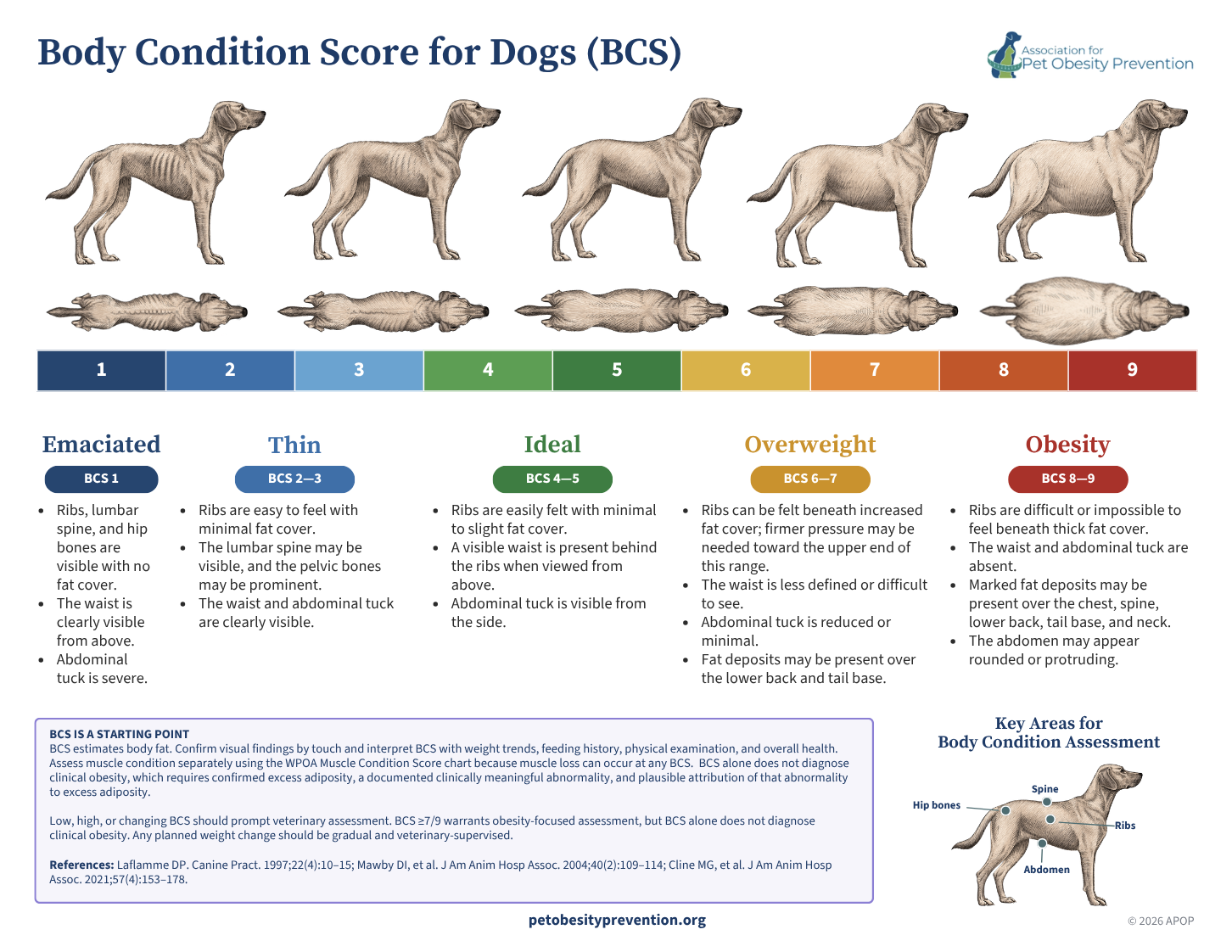
APOP 2026 quick visual dog body condition score guide

Detailed 9-point chart

Clinical detail

Each score is shown separately with fuller criteria for assessment, documentation, and teaching.
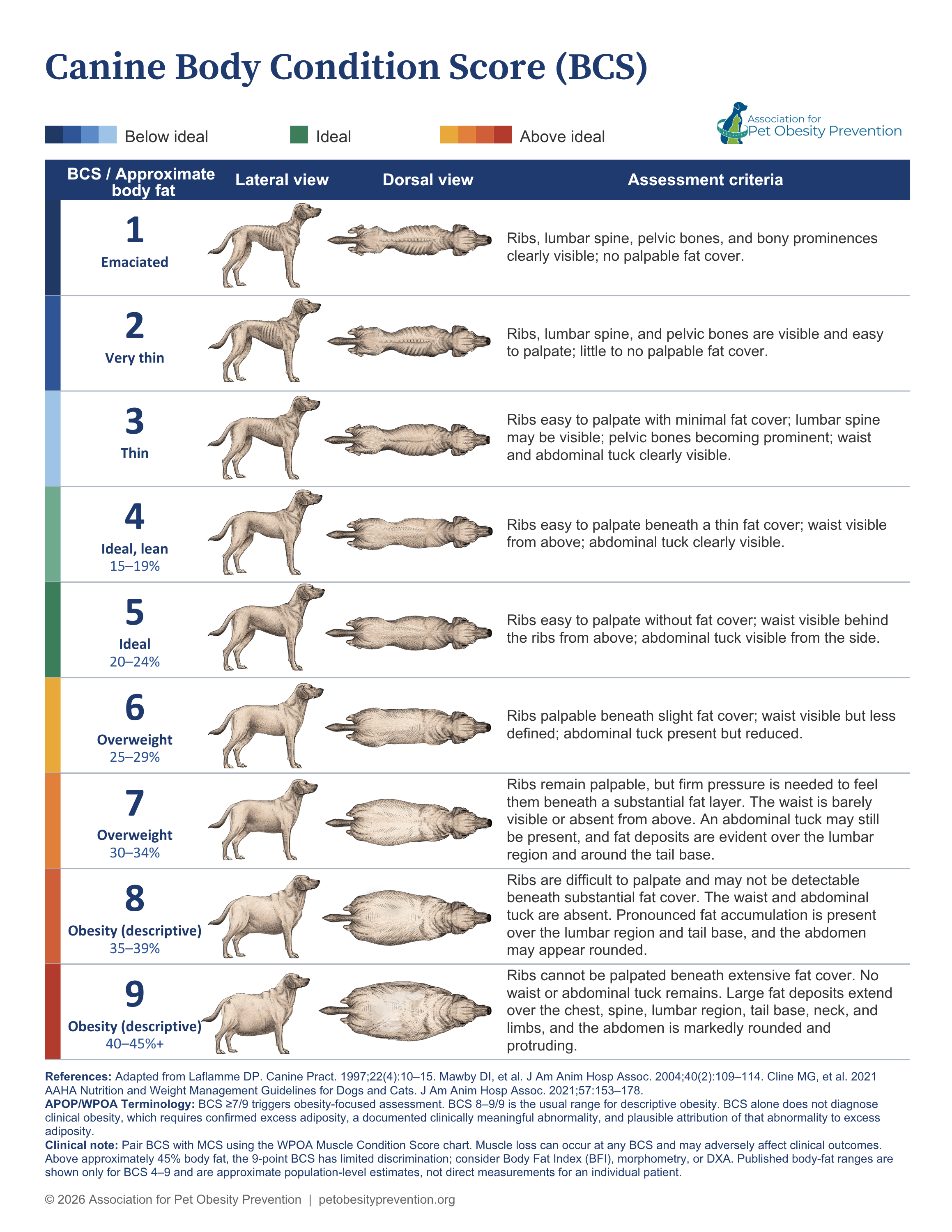
APOP nine-point clinical body condition score chart for dogs
All nine scores and body fat estimates Criteria · sources
Canine body condition score, 1 to 9, with body fat estimates
BCSConditionBody fat
1Emaciated<5%
2Very Thin5–9%
3Thin10–14%
4Healthy (lean)15–19%
5Healthy (ideal)20–24%
6Overweight25–29%
7Overweight30–34%
8Obesity (descriptive)35–39%
9Obesity (descriptive)40–45%+

Clinical obesity screening zone (BCS 7–9)

  • 1Ribs, lumbar spine, pelvic bones, and bony prominences plainly visible; no palpable fat cover.
  • 2Ribs, lumbar spine, and pelvic bones are visible and easy to palpate; little to no palpable fat cover.
  • 3Ribs easy to palpate with minimal fat cover; lumbar spine may be visible; pelvic bones becoming prominent; waist and abdominal tuck clearly visible.
  • 4Ribs easy to palpate beneath a thin fat cover; waist visible from above; abdominal tuck clearly visible.
  • 5Ribs easy to palpate without excess fat cover; waist visible behind the ribs from above; abdominal tuck visible from the side.
  • 6Ribs palpable beneath slight excess fat cover; waist visible but less defined; abdominal tuck present but reduced.
  • 7Firm pressure is required to palpate ribs through heavy fat cover; waist difficult to see; abdominal tuck minimal; fat deposits present over the lower back and tail base.
  • 8Ribs are difficult or impossible to palpate through heavy fat cover; waist and abdominal tuck absent; fat deposits evident over the lower back and tail base; abdomen may appear rounded.
  • 9Ribs cannot be palpated through extensive fat cover; waist and abdominal tuck absent; extensive fat deposits over the chest, spine, lower back, tail base, neck, and limbs; abdomen rounded and protruding.

Terminology: BCS 7–9 is a clinical obesity screening zone, not a diagnosis. Obesity (descriptive) indicates excess adiposity based on body condition; clinical obesity refers to excess adiposity accompanied by clinically meaningful abnormalities plausibly attributable to adiposity and requiring medical intervention.

Clinical note: Pair BCS with MCS using the WPOA Muscle Condition Score chart. Muscle loss can occur at any BCS and may adversely affect clinical outcomes. Above approximately 45% body fat, BCS becomes less reliable; consider Body Fat Index (BFI), morphometry, or DXA. Body-fat estimates may vary with sex, neuter status, activity, and breed.

Sources: Adapted from Laflamme DP. Canine Pract. 1997;22(1):10–15. Mawby DI, et al. J Am Anim Hosp Assoc. 2004;40(2):109–114. Cline MG, et al. 2021 AAHA Nutrition and Weight Management Guidelines for Dogs and Cats. J Am Anim Hosp Assoc. 2021;57:153–178.

Body Condition Score

Cat BCS charts

Choose an easy-reference overview or a complete score-by-score chart.

Quick visual guide

Easy reference

A clear overview for pet owners, veterinary teams, and general education.
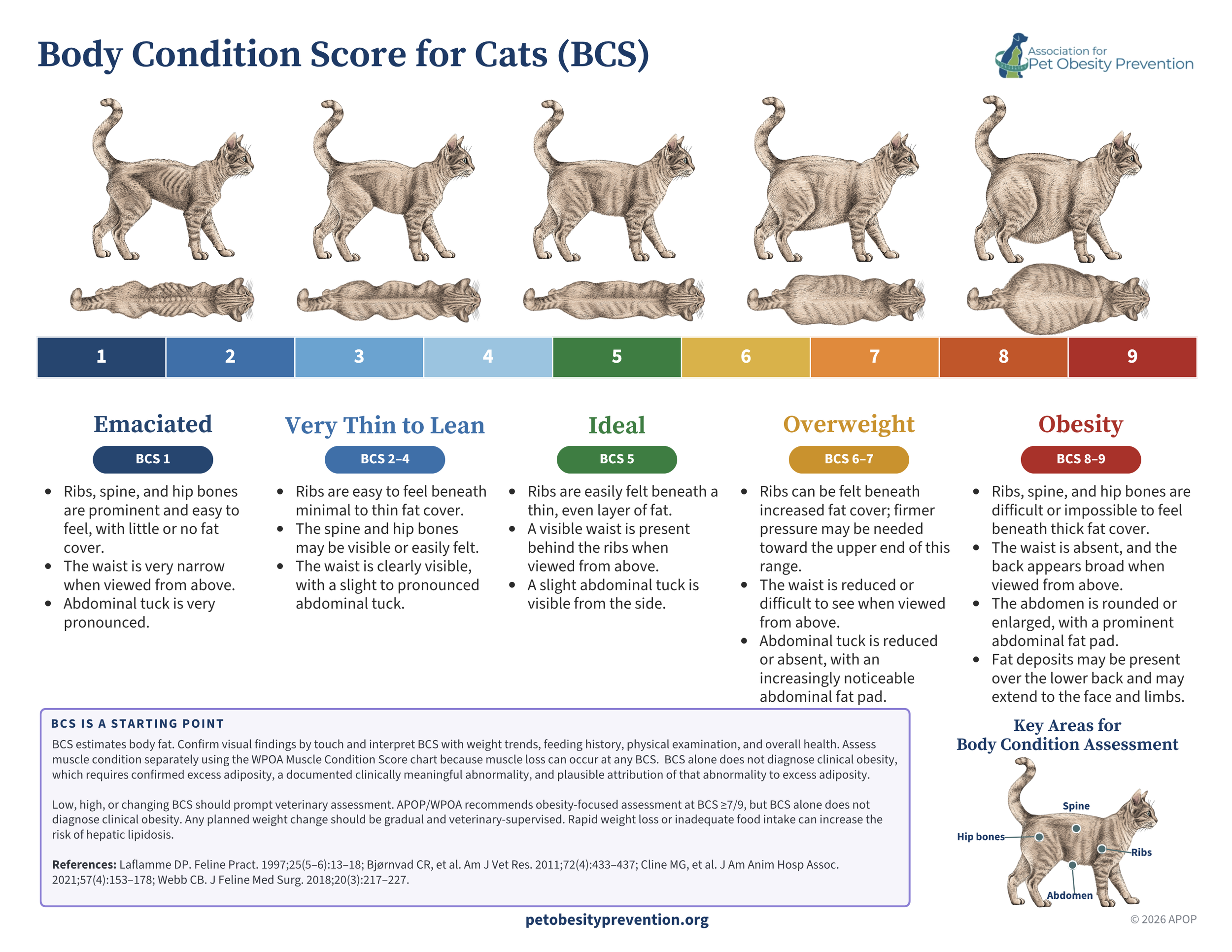
APOP 2026 quick visual cat body condition score guide

Detailed 9-point chart

Clinical detail

Each score is shown separately with fuller criteria for assessment, documentation, and teaching.
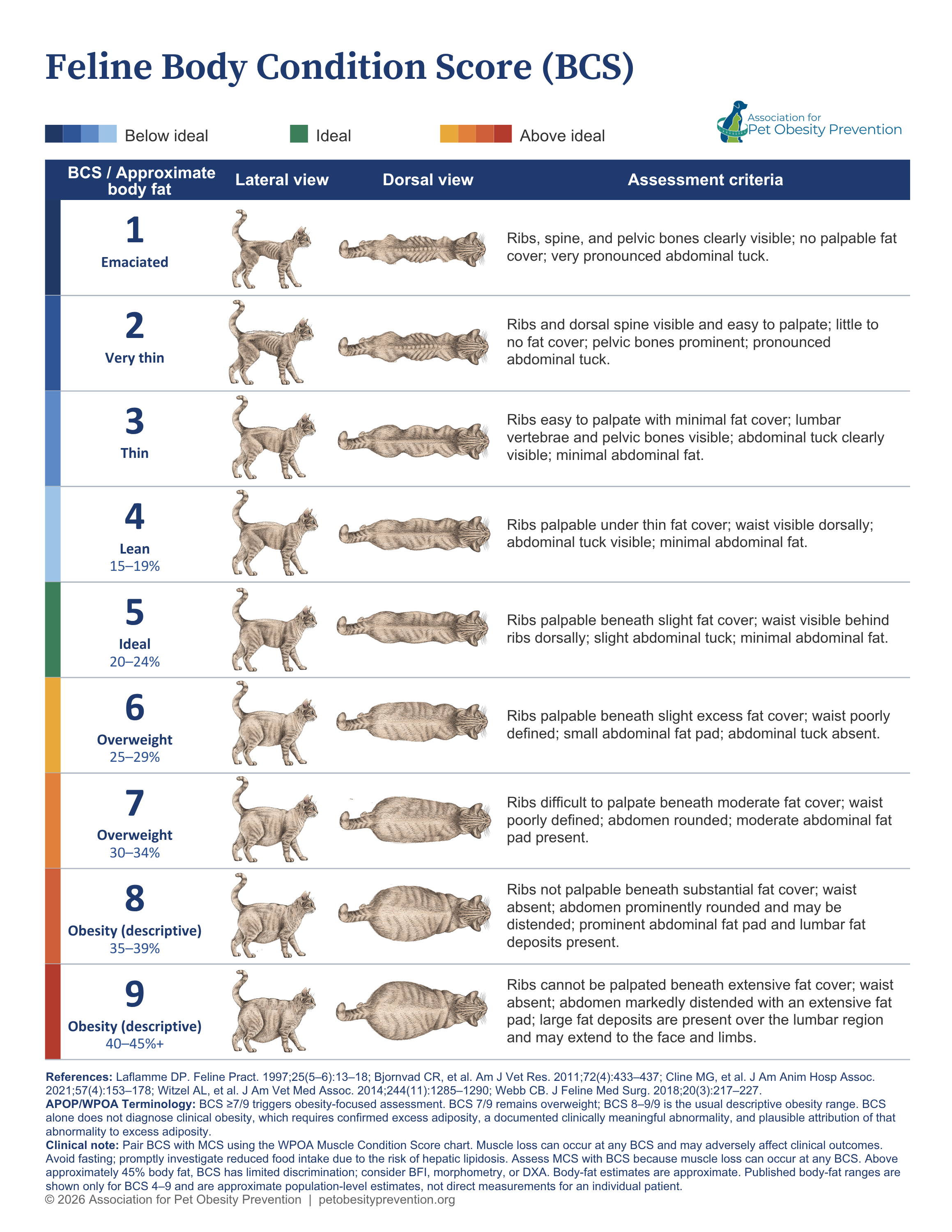
APOP nine-point clinical body condition score chart for cats
All nine scores and body fat estimates Criteria · sources
Feline body condition score, 1 to 9, with body fat estimates
BCSConditionBody fat
1Emaciated<5%
2Very Thin5–9%
3Thin10–14%
4Lean15–19%
5Healthy (ideal)20–24%
6Overweight25–29%
7Overweight30–34%
8Obesity (descriptive)35–39%
9Obesity (descriptive)40–45%+

Clinical obesity screening zone (BCS 7–9)

Cats are different. Avoid rapid caloric restriction because of the risk of hepatic lipidosis. A cat is ideal at 5 only, so a BCS of 4 is below ideal in cats even though it is healthy in dogs.

  • 1Ribs, spine, and pelvic bones clearly visible; no palpable fat cover; very pronounced abdominal tuck.
  • 2Ribs and dorsal spine visible and easy to palpate; almost no fat cover; pelvic bones prominent; pronounced abdominal tuck.
  • 3Ribs easy to palpate with minimal fat cover; lumbar vertebrae and pelvic bones visible; abdominal tuck clearly visible; minimal abdominal fat.
  • 4Ribs palpable under slight fat cover; waist visible dorsally; abdominal tuck visible; minimal abdominal fat.
  • 5Ribs palpable with slight fat cover; waist visible behind ribs dorsally; slight abdominal tuck; minimal abdominal fat.
  • 6Ribs palpable under slight excess fat cover; waist poorly defined; small abdominal fat pad; abdominal tuck absent.
  • 7Firm pressure needed to palpate ribs; waist difficult to see; moderate abdominal fat pad.
  • 8Ribs cannot be palpated through heavy fat cover; waist absent; prominent abdominal fat pad; abdomen distended; lumbar fat deposits.
  • 9Ribs cannot be palpated through extensive fat cover; large abdominal fat pad; fat deposits over lumbar region, face, and limbs.

Terminology: BCS 7–9 is a clinical obesity screening zone, not a diagnosis. Obesity (descriptive) indicates excess adiposity based on body condition; clinical obesity refers to excess adiposity accompanied by clinically meaningful abnormalities plausibly attributable to adiposity and requiring medical intervention.

Clinical note: Avoid rapid caloric restriction because of the risk of hepatic lipidosis. Pair BCS with MCS using the WPOA Muscle Condition Score chart. Muscle loss can occur at any BCS and may adversely affect clinical outcomes. Above approximately 45% body fat, BCS becomes less reliable; consider Body Fat Index (BFI), morphometry, or DXA. Estimates vary with sex, neuter status, activity, and breed.

Sources: Adapted from Laflamme DP. Feline Pract. 1997;25:13–18. Bjornvad CR, et al. Am J Vet Res. 2011;72:433–437. Cline MG, et al. 2021 AAHA Nutrition and Weight Management Guidelines for Dogs and Cats. J Am Anim Hosp Assoc. 2021;57:153–178.

Body Condition Score

Rabbit BCS chart

A practical visual reference for estimating body condition in rabbits.

Quick visual guide

Easy reference

A 1–9 overview for rabbit owners, veterinary teams, and general education.

APOP rabbit body condition score chart
All nine scores Criteria · sources
Rabbit body condition score, 1 to 9
BCSCondition
1Emaciated
2Thin
3Thin
4Healthy (lean)
5Healthy (ideal)
6Overweight
7Overweight
8Obesity
9Obesity

Clinical obesity screening zone (BCS 7–9)

  • 1Ribs, spine, and hip bones are very sharp and easily felt, with no fat cover; the back is sunken and the sides feel hollow, and the rump narrows toward the tail; any dewlap is absent and the body feels bony all over; the abdominal area is markedly tucked and hollow, with obvious loss of soft tissue.
  • 2Ribs, spine, and hips are easy to feel under only a very thin covering; the back is flat to slightly sunken, and the rump is narrow with prominent bony contours; dewlap is absent or very thin, with minimal soft tissue over the chest and neck; the abdominal profile is deeply tucked, suggesting reduced reserves.
  • 3Ribs and spine are easily felt with minimal fat cover; the back is straight, and the rump is flat with the pelvis still clearly outlined; dewlap, when present, is small and lightly padded; the abdomen is tucked with a pronounced upward curve, and overall soft tissue is reduced.
  • 4Ribs and spine can be felt with light pressure, covered by a smooth, thin layer of tissue; the back is straight to gently rounded, and the rump is flat toward the tail without bulging; dewlap is proportionate to body size and not heavily padded; the abdominal profile is tucked but not extreme, with a clear, healthy contour.
  • 5Ribs and spine are palpable with gentle pressure under a light, even fat cover; the back is gently rounded, and the rump feels firm and filled but not bulging; dewlap, when present, is soft and proportionate, without pendulous folds; the abdomen shows a slight tuck with a smooth outline, and body shape appears balanced.
  • 6Ribs and spine are difficult to feel without firm pressure because of increased fat cover; the back is broadly rounded, and the rump is rounded at the base of the tail; dewlap is clearly noticeable and cushioned; the abdominal profile is reduced or absent, and the underside appears rounded rather than tucked.
  • 7Ribs and spine are hard to feel even with firm pressure; the back appears broad and rounded, and fat can be felt over the pelvis and hips; dewlap is enlarged and visibly padded, with obvious soft tissue under the chin; the abdomen is rounded and may sag, and fat deposits are palpable along the flank region.
  • 8Ribs and spine are very difficult to feel beneath thick fat cover; the back is markedly rounded, and the rump bulges outward with heavy fat over the pelvis; dewlap is large and pendulous, with pronounced fat accumulation; the abdominal profile is convex and sagging, and obvious fat pads are present along the flanks and limbs.
  • 9Ribs and spine cannot be reliably felt, even with deep pressure; the body is barrel-shaped from above, and the rump is heavily bulging; dewlap is very large and may form multiple folds, and excess soft tissue interferes with normal movement or grooming; the abdominal area hangs prominently, and extensive fat deposits are present around flanks, chest, and limbs.

BCS is a starting point. BCS provides a structured estimate of fat cover and overall body condition. Confirm visual findings by gentle palpation and interpret BCS with weight trends, feeding history, physical examination, mobility, and overall health. Assess muscle condition separately because muscle loss can occur at any BCS. Dewlap size varies with sex, reproductive status, and breed and should not be used alone to assign BCS.

Clinical note: Low, high, or changing BCS should prompt further assessment. BCS 7–9 is a clinical obesity screening zone, not a diagnosis. Further evaluation is needed to determine whether excess adiposity is affecting health or function. Any planned weight change should be gradual and monitored by a veterinary professional. Reduced or absent food intake requires prompt veterinary attention.

Scale note: This APOP 1–9 rabbit BCS chart is a practical educational framework informed by rabbit-specific and companion-animal body condition scoring literature and designed for consistency with APOP’s cat and dog charts. This scale has not been independently validated against an objective measure of adiposity.

Body Condition Score

Horse BCS charts

Choose an easy-reference overview or a more detailed chart that includes score-by-score criteria.

Quick visual guide

Easy reference

A clear overview for horse owners, veterinary teams, and general education.
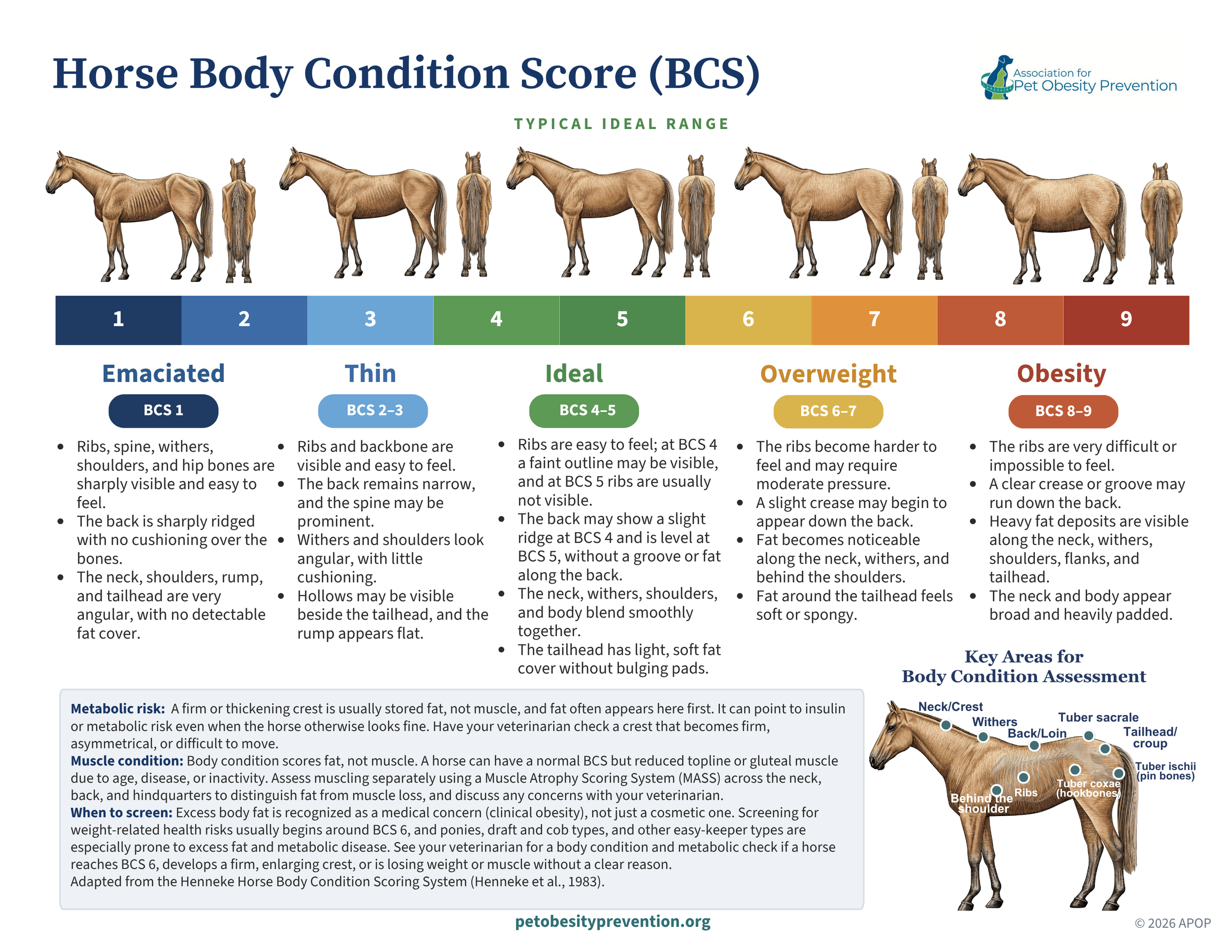
APOP quick visual horse body condition score guide

Detailed 9-point chart

Clinical detail

Expanded assessment criteria with additional clinical scoring information for documentation and teaching.

APOP nine-point clinical body condition score chart for horses, with Cresty Neck Score and Muscle Atrophy Score
All nine scores Criteria · sources
Equine body condition score, 1 to 9
BCSCondition
1Emaciated
2Very Thin
3Thin
4Healthy (Lean) Performance horses
5Ideal
6Above Ideal
7Overweight
8Obesity
9Obesity (Severe)

Clinical obesity screening zone (BCS 6–9)

  • 1Spinous processes, ribs, tailhead, and hook and pin bones project prominently; bone structure of withers, shoulders, and neck easily noticeable; no palpable fatty tissue.
  • 2Slight fat over base of spinous processes; transverse processes of lumbar vertebrae feel rounded; ribs, tailhead, hook and pin bones prominent; withers, shoulders, and neck faintly discernible.
  • 3Fat buildup halfway on spinous processes; ribs discernible with slight fat cover; tailhead prominent but individual vertebrae not felt; hookbones rounded; withers, shoulders, and neck accentuated.
  • 4Negative crease along back; faint outline of ribs discernible; fat felt at tailhead though prominence varies; hookbones not discernible; withers, shoulders, and neck not overtly thin.
  • 5Back is level; ribs cannot be visually distinguished but are easily palpable; fat around tailhead feels spongy; withers rounded over spinous processes; shoulders and neck blend smoothly into body.
  • 6Slight crease down back; fat over ribs feels spongy; fat around tailhead soft; fat beginning to deposit along sides of withers, behind shoulders, and along neck.
  • 7May have crease down back; individual ribs can be felt but noticeable fat fills between them; tailhead fat soft; fat deposited along withers, behind shoulders, and along neck.
  • 8Positive crease down back; ribs difficult to feel through heavy fat; tailhead very soft; area along withers filled with fat; area behind shoulders flush with body; neck noticeably thickened.
  • 9Obvious crease down back; fat deposits visible over ribs; bulging fat at tailhead, along withers, behind shoulders, and neck; inner thigh fat may rub; flank filled in flush.

Screening: Screening begins at BCS 6; assess for insulin dysregulation (ID), especially in ponies, native breeds, and other metabolically predisposed types, or with CNS ≥ 3. In these types, clinical intervention is recommended at BCS 6. At BCS ≥ 7, BCS reliability as a fat predictor decreases; supplement with CNS, MASS, and morphometric assessment.

Clinical note: BCS 4-5 is ideal for most horses; breeding mares 5–6. BCS 4 is appropriate for performance horses and should not be interpreted as underconditioned. BCS, CNS, and MASS are independent measures; assess each separately. No validated per-score body fat estimates exist for horses (Dugdale et al. 2012). MASS assesses neck, back, and hind regions only; the abdominal region is excluded due to poor inter-rater reliability (Herbst et al. 2022).

Sources: Henneke (1983) · Carter (2009) · Herbst et al. (2022) · Dugdale (2012) · ECEIM EMS Consensus (2019).

Muscle Condition Score

Dog & cat MCS chart

MCS evaluates skeletal muscle independently of body fat. Use the combined chart to assess five muscle sites and describe the worst muscle loss as normal, mild, moderate, or severe.

Combined dog and cat muscle condition chart

Clinical guide

A detailed chart for clinical assessment, documentation, teaching, and guided client education.
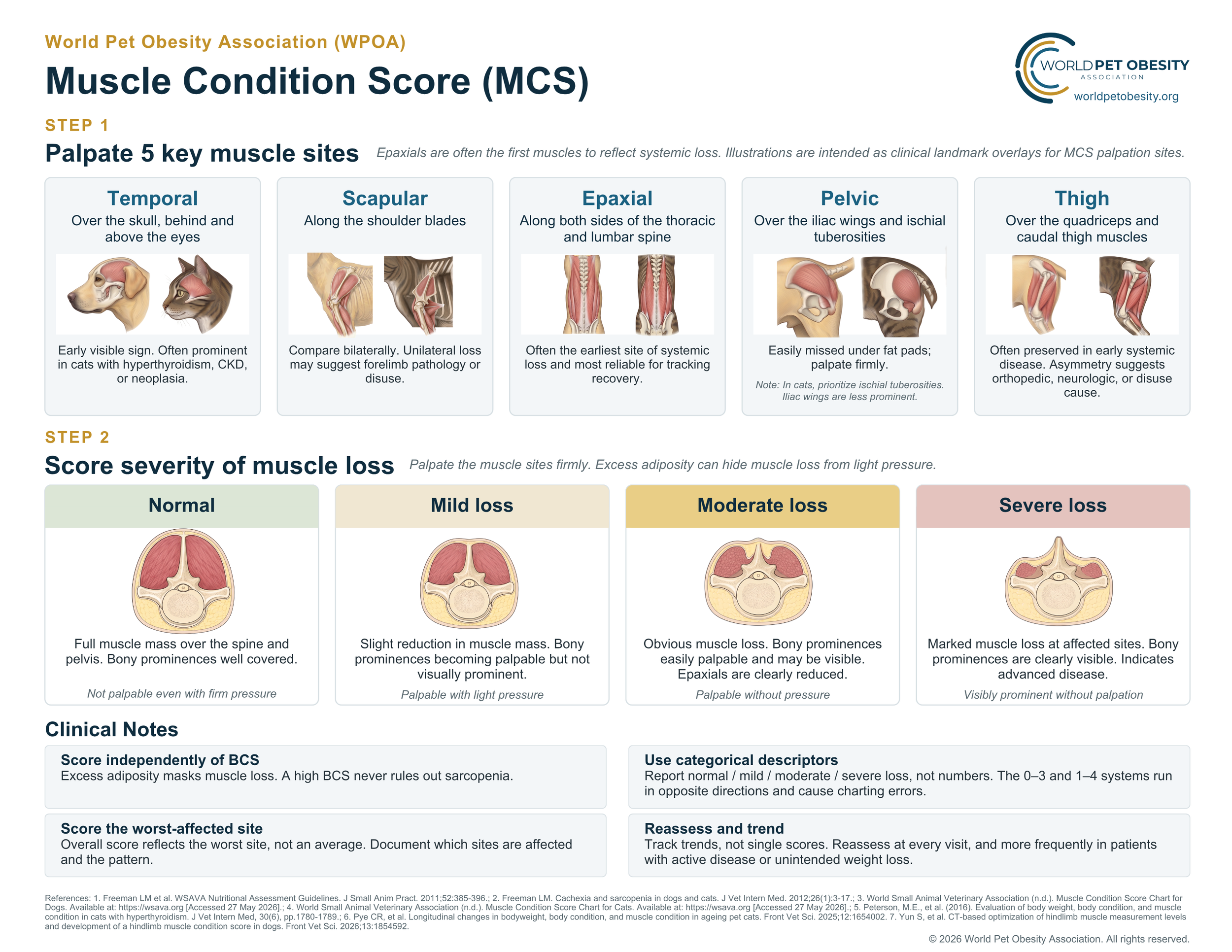
Muscle condition score chart showing five palpation sites and scoring categories for dogs and cats
Use the charts as part of a complete assessment. Images are a starting point. Confirm BCS and MCS by palpation, watch for changes over time, and ask a veterinarian to assess unexpected weight change, weakness, or muscle loss.