


2026 Pet Obesity Communication Guidelines Words that put
pets first.
The standard for respectful, accurate conversations about pet obesity, from the exam room to the newsroom.

Version 2.0 · September 2026 · Replaces the 2025 edition · doi.org/10.68316/apop.0002
Instead of a chonky cat
a cat with obesity
Name the pet first. Name the condition second.
Five rules for pet obesity communication
The Pet Obesity Communication Standard, in practice.
- Use pet-first and person-first language.
- Connect body condition to health and function.
- Explain why pet obesity develops without blaming the pet owner.
- Match the claim to the evidence.
- End with one clear next step, and who to ask.
Why this matters
The words decide what happens next.
“We are already good at being gentle. Where we fall short is precision. Changing one word will not change a patient’s body condition. But the words decide whether the conversation happens at all, what goes into the record, and what the pet owner remembers on the drive home.”
Ernie Ward, DVM, from the author’s note · Read the full note
Start here
Choose your role
Each role opens its own set of wording, tools, and links, right below the buttons. Pick the closest one.
Opened from your last visit. Pick another role above, or .
For veterinary teams
Explain what you found, hear the pet owner’s perspective, and agree on a plan the household understands and can carry out.
Before the conversation
- Ask about life at home first, then connect the body-condition finding to what they told you.
- If the visit is for something else, ask before you advise: “May I share what I found on her body condition?”
- Say the body-condition score, the range, and how you assessed it. Offer to show them.
- Keep the cause open until it has been assessed. A high BCS is a finding, not a diagnosis.
- One clear recommendation, one first action, a recheck date, and who to call.
Clinical tools (APOP and WPOA)
Diagnosing and classifying clinical obesity
Body-condition score identifies excess body fat. Whether that excess has become a disease in this patient is a separate clinical question. The World Pet Obesity Association framework sets out how that question is answered and recorded.
- The four tiers, and what separates each one
- The Three A’s: adiposity, abnormality, attribution
- The decision tree, step by step
- The Minimum Obesity Database
Wording that works in the exam room
| Situation | Helpful wording | Why it helps |
|---|---|---|
| Routine visit, BCS 7/9 | “Her body-condition score is 7 out of 9, in the overweight range. Could everyone at home record all food, snacks, and amounts for three days? We can use that to adjust her feeding plan.” | Gives a specific task instead of asking the pet owner to calculate calories without help. |
| Obesity-range body condition, health effect not yet known | “His BCS is 8 out of 9, in the obesity range. That does not tell us whether the excess body fat is affecting his health. Let’s start a diagnostic plan and finish the other tests we discussed.” | Separates the body-condition finding from deciding whether excess fat is contributing to illness. |
| The visit is for something else, and the pet owner has not raised weight | “Before you go, may I share one thing I found on Gus’s body condition? It’s something we can help with.” | Asking first turns a verdict into a finding to discuss. In a 2026 study of adults with obesity (human data), a doctor recommending a diet when they had not come in about weight was the most common stigmatizing experience. |
| Pet owner says the pet is fine; exam and tests are normal, BCS 8/9 | “That’s good news, and her tests agree: nothing is wrong yet. Her body-condition score is 8 out of 9, so now, while she feels well, is the time to start.” | Agrees with what is true, then explains why a pet with no illness yet still has a reason to act. |
| Pet owner accepts treatment but objects to the word | “The word describes her body fat, not your care. We record it so everyone who treats her knows. The plan is about her hips.” | Keeps the finding in the record and in the plan, and separates it from any judgment of the household. |
| Pet owner has limited mobility | “What activities are safe and comfortable for her and manageable for you? We can consider indoor activities or help from someone else rather than relying on longer or faster walks.” | Asks what is possible instead of assuming longer walks will work. |
| Cost is a concern | “What concerns do you have about cost or getting the food and care she needs? I’ll explain the choices and recheck costs before we decide.” | Makes affordability part of the discussion without assuming a budget. |
| Progress has slowed | “Her weight loss has slowed. What has been easiest and hardest at home? Let’s review what she eats, her activity, her health, and the revised plan before deciding what to change.” | Investigates the change without assuming failure or promising that one adjustment will solve it. |
Veterinary team: “He’s clearly well loved. How has Bruno been managing the stairs lately?”
Pet owner: “Slower than last year. He waits at the bottom sometimes.”
Veterinary team: “That is useful to know. His body-condition score is 8 out of 9, which is in the obesity range. May I show you how I assessed that? Then we can talk about the stairs and the next step.”
Findings: BCS 8/9. Muscle condition normal. Reduced mobility reported.
Assessment and plan: Assess the mobility problem and its possible causes. It is not yet clear whether excess body fat is contributing. Record the agreed care plan and further checks.
Check your own drafts, explore the terms, and run the short training below. The pet-owner page can be printed or shared as a handout after the visit.
More from the guidelines for veterinary teams
Wording to use, and wording to replace
| Say this | Instead of |
|---|---|
| A dog with obesity | An obese dog |
| A cat with an overweight body condition | An overweight cat used as a defining label |
| A person or pet owner with obesity | An obese owner |
| Comfort, mobility, function, and quality of life | Appearance, guilt, or ridicule as the reason to act |
| A specific recommendation and one workable next step | Generic “feed less and exercise more” advice |
| A whole pet in an ordinary, respectful setting | A cropped body part or humiliating pose used for shock |
| A statement that names the species, group studied, method, and source | “Crisis,” “epidemic,” or “surge” without comparable evidence |
Define the terms on first use in records and handouts, and keep direct quotations and published titles exactly as written.
Confirming the pet owner understood, without making it a test
Teach-back puts the burden on the explanation, not the pet owner.
Give a little information at a time, pause for questions, and end with a written summary of the first step, the recheck date, and who to contact.
Photographs, records, and what you can and cannot claim from an image
- Clinical and teaching images need a clear purpose: show the anatomy needed and explain the crop. Protect privacy and get permission for the intended use.
- Do not alter body shape, and do not turn a clinical close-up into a public post.
- A photograph cannot establish a body-condition score, muscle condition, or obesity stage. Use validated assessment resources for that.
- For before-and-after stories: get permission, match pose, distance, coat, lighting, and setting, give dates, report what was measured, and explain any other care given at the same time. One result does not show what others can expect.
- Label whether an image is a real patient, staged, from a library, or AI-generated, and add brief alt text.
When a pet owner uses a nickname, or when the conversation gets stuck
The euphemism is often ours. In APOP’s 2024 Pet Obesity and Nutrition Opinion Survey, veterinary professionals reported using terms such as “overweight,” “obese,” “fat,” “chunky,” and “chubby,” while pet owners recalled hearing their veterinary professional use euphemisms such as “chonky,” “fluffy,” and “well-fed.” Those words can feel kind in the room and blur the clinical significance by the time the household gets home. Acknowledge the affection, then give the finding and the next step.
Affection and concern coexist. Do not assume knowledge, motivation, or expectations from the species or from a nickname; ask what they have noticed and understood. If a professional account you run attracts comments promoting extreme food restriction or unverified treatments, address them.
If cost is the obstacle, ask what concerns they have about cost or access before recommending, and explain the choices and recheck costs before deciding. If activity is the obstacle, ask what is safe and comfortable for the pet and manageable for the household rather than assuming longer walks.
Correcting a colleague, a supplier, or a draft
A correction lands better as a question: “Would you consider changing ‘obese dog’ to ‘dog with obesity’?” or “This source does not establish illness linked to excess body fat. Could we describe the body-condition finding using the study’s method and cutoffs?”
Where to go next
For pet owners
Your pet’s veterinary team should explain what they found about your pet’s body condition, listen to your concerns, and help you leave with a weight-management plan you understand and can use, without feeling blame.
What to expect from your veterinary team
- They show you what they found rather than relying on a label or term.
- They explain what body condition and weight may mean for your pet’s health, comfort, movement, or daily life.
- They ask about food, snacks, activity, health, cost, routines, and everyone who feeds your pet.
- They respect your lifestyle and ask how best to fit a weight-loss plan into your life.
- You receive a clear recommendation and a plan that can work in your household on your schedule.
- You know what happens next, who to contact, and when progress will be reviewed.
Four questions to cover before you leave
- “What did you find, and what does it mean for my pet?”
- “What do you recommend we do first?”
- “How can we make this work in our household?”
- “When will we review the plan, and who can I contact?”
If the score surprises you
You are not alone. In APOP’s 2022 survey, about a third of pet owners whose pets were in the overweight or obesity range described their pet as normal. Body condition is hard to judge by eye, which is why your veterinary team scores it by hand. Ask them to show you where they feel the ribs, the waist, and the belly.
If the language feels hurtful or unclear
You can ask for different wording or more detail. These are options, not statements you are expected to use.
“I’d rather focus on her health than the label. What does this mean for her comfort, how she moves, or how long she might live?”
“Could you say she has obesity instead? I don’t love the word obese.”
“We’re already doing our best with her. Tell me what one thing would help the most today.”
You can also raise these concerns later, with a veterinary technician, on a feedback form, or in a private message. If a phone or online visit would be more comfortable for you, ask whether your clinic offers one.
About weight-loss foods
Therapeutic weight-loss foods are specially formulated to meet nutritional needs while providing fewer calories. Most dogs and cats with a body-condition score of 6 to 9 out of 9 will need one to maintain health, preserve muscle, get the protein, vitamins, and minerals they need, and feel full while safely reducing calories. Some pets with a score of 6, needing only a small calorie reduction, do well on a food intended for maintaining weight. Ask your veterinary team which option meets your pet’s needs.
Tools you can use at home
Your agreed first step
Write down with your veterinary team: your pet’s name and health goal, the first action and start date, who will do it, what might make it difficult and what to do instead, the review date and what will be checked, and contact details for help sooner. It is not a feeding prescription; confirm the details with your veterinary team.
More for pet owners
Why your veterinary team looks at body condition and not just the scale
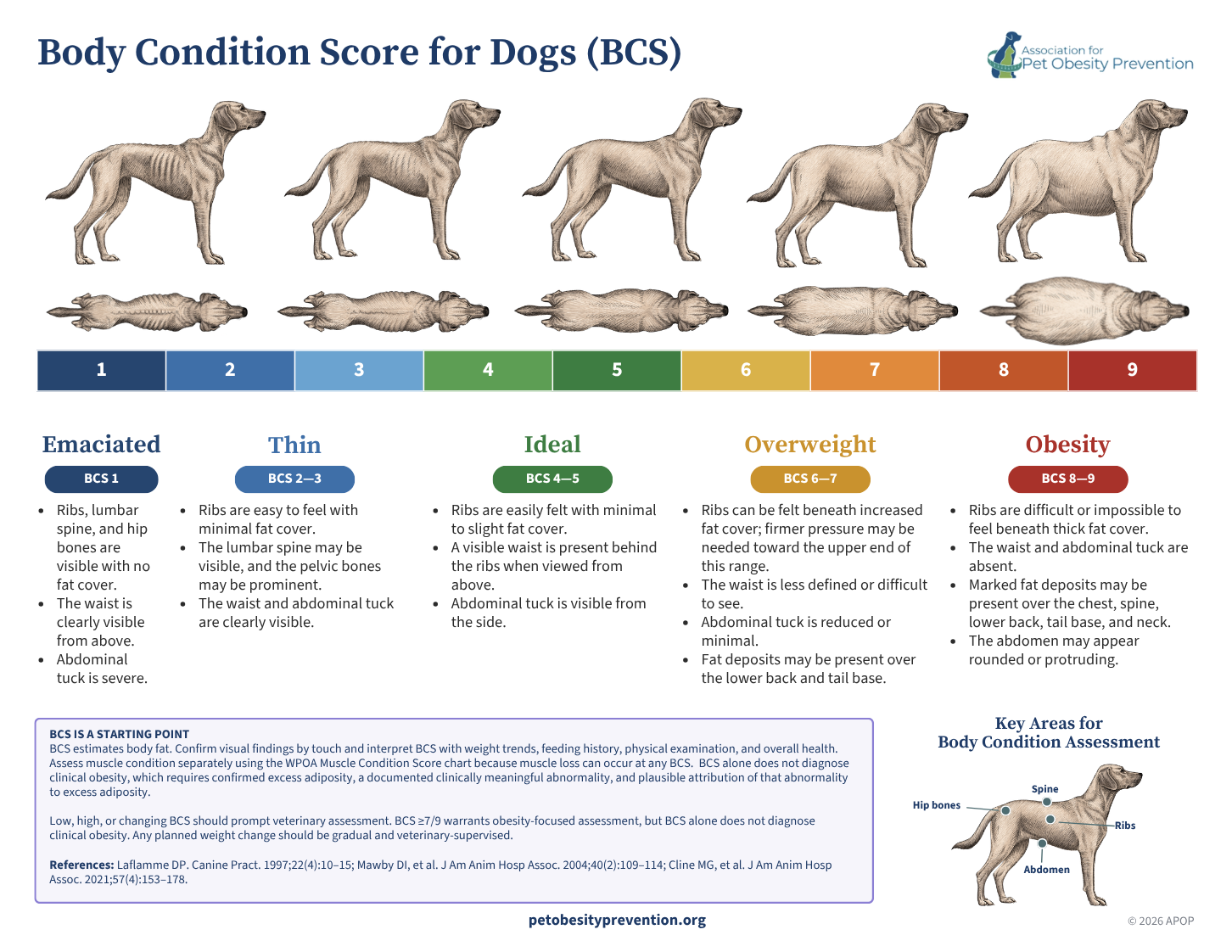
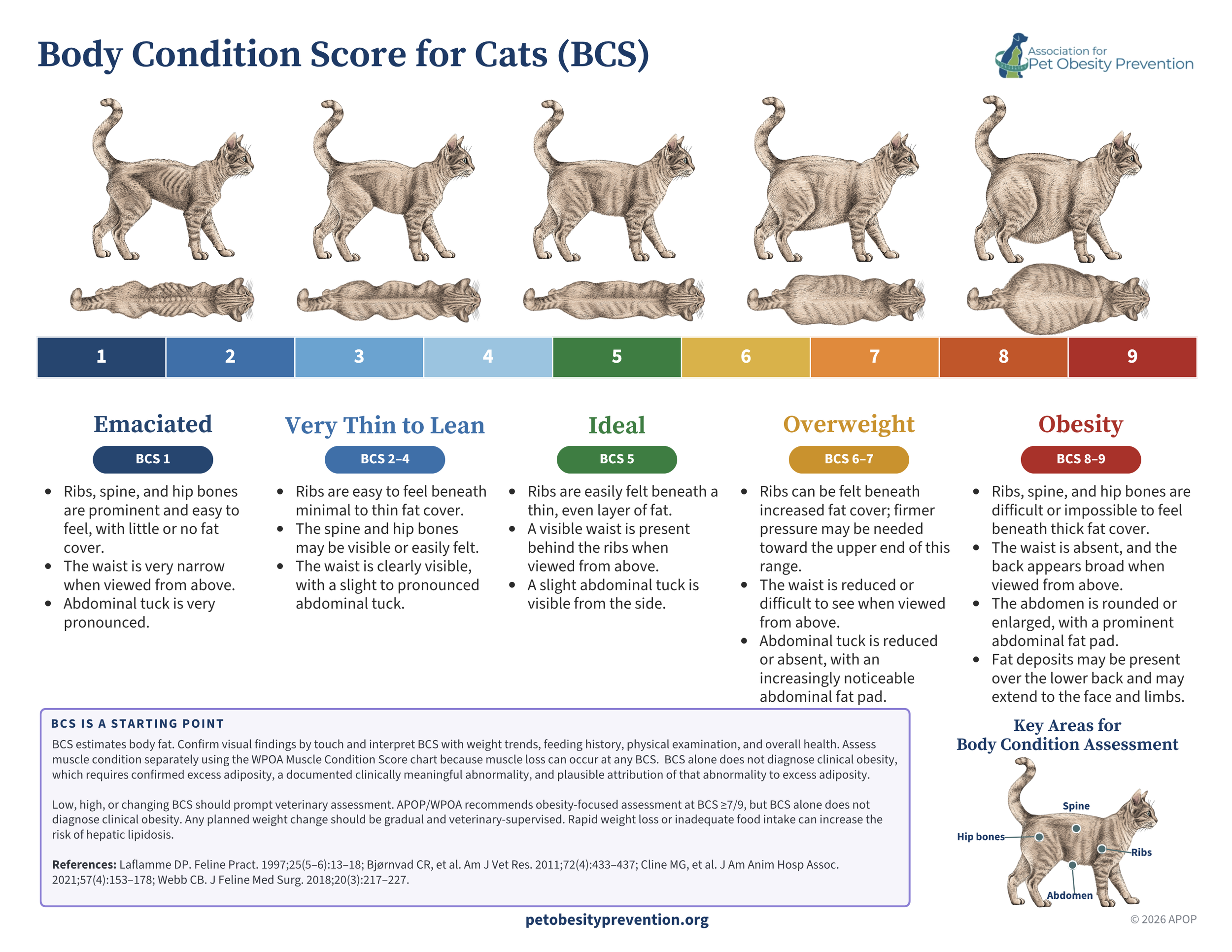
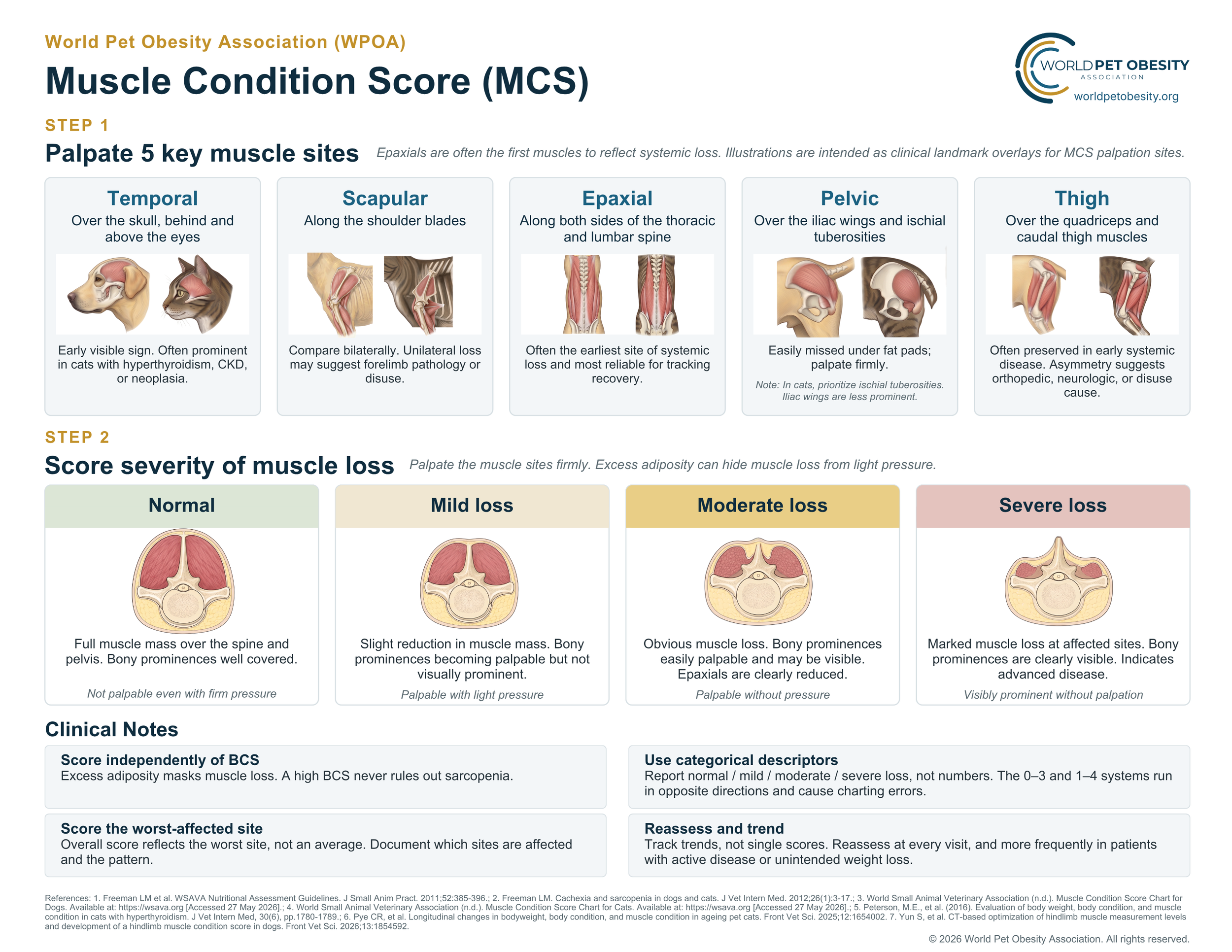
Body condition is a hands-on check of how much body fat your pet is carrying, scored on a 9-point scale by sight and touch. Weight alone cannot tell whether a particular number is right for your individual pet, and two pets of the same weight can have very different amounts of body fat and muscle. Muscle condition is checked separately, because muscle loss can happen at any body condition.
You can ask to see the chart and be shown how the body-condition score is assigned. Owners who are shown how to check body condition assess their own pet more accurately.
What your veterinary team may ask you, and what is worth bringing
- Everything your pet eats in a normal day: meals, treats, chews, table food, food used for medication, and who gives it.
- What activity looks like now, and what is realistic for your household.
- Any changes you have noticed: stairs, jumping, grooming, breathing, sleep, or mood.
- What has been tried before, what worked, and what did not.
- Anything that makes a plan hard: cost, time, other people in the house, other pets, your own health or mobility.
A three-day written food diary, including who gave what, is one of the most useful things you can hand your veterinary team.
If a post or an article about pet obesity upsets you
You are allowed to say so. Public material about pet weight sometimes uses ridicule, blame, or before-and-after pictures that promise results nobody can guarantee. The guidelines ask writers and clinics to show whole pets in ordinary settings, explain contributing factors without blaming households, and avoid guaranteeing an outcome. If something you read does not do that, you can ask the publisher or clinic to reconsider it, and you can ask your own team for the version of the information that fits your pet.
What a good plan includes
- What was found, in plain words, and what it means for your pet’s comfort, movement, or health.
- One first action, with a start date and the person who will do it.
- What might make it difficult, and what to do instead.
- A recheck date and what will be checked, including body condition and muscle condition.
- Who to contact if something changes sooner.
Rapid weight loss is not the goal, and in cats it can raise the risk of hepatic lipidosis, a serious liver condition. Changes should be gradual and supervised by your veterinary team.
Where to go next
For journalists and editors
Respectful reporting also needs accurate headlines and numbers. Be clear about whether the evidence shows cause and effect.
Report what was measured
A body-condition score (BCS) estimates body-fat level. It does not, by itself, establish whether excess body fat is affecting health or function. A study that measured BCS can report body condition in the overweight or obesity range. It should not report preclinical or clinical obesity prevalence unless the study also assessed health effects and their relationship to excess body fat.
Give every number its context
- Species and age or life stage
- Country, region, practice network, shelter, or community
- Study years, sample size, and how records were selected
- How body condition was measured and who assigned it
- Which body-condition scores or diagnoses counted as overweight or obesity
- Whether the result describes one period or a fair change over time, and how uncertain it is
How to report it: “About 6 in 10 dogs and cats assessed at US veterinary clinics were in the overweight or obesity range” is accurate, and still newsworthy. “Half of US pets are clinically obese” is not.
| Replace | With |
|---|---|
| “Meet the nation’s fattest cat” | “Inside one cat’s veterinary weight-management plan” |
| “Lazy owners are making pets fat” | “Why pets gain body fat, and what can help” |
| “Obese dog cured by miracle diet” | “Dog’s mobility improves during supervised weight management” |
| “Pudgy pups: the chubbiest dog breeds revealed” | “Breed differences in recorded body condition: what the data show” |
Keep these separate
- Association: a measured relationship. Do not substitute “caused.”
- Prevalence: the proportion with a finding in a named group and period.
- Risk or odds: name the measure the study used; do not relabel an odds ratio as a risk ratio.
- Causal effect: only when the study design supports it.
Sources
More from the guidelines for journalists and editors
Headlines: four rewrites that keep the story
| Replace | With |
|---|---|
| “Meet the nation’s fattest cat” | “Inside one cat’s veterinary weight-management plan” |
| “Lazy owners are making pets fat” | “Why pets gain body fat, and what can help” |
| “Obese dog cured by miracle diet” | “Dog’s mobility improves during supervised weight management” |
| “Pudgy pups: the chubbiest dog breeds revealed” | “Breed differences in recorded body condition: what the data show” |
Only report an improvement in a headline when that change was documented in the study.
Quotes, experts, and declared interests
Name each expert’s qualifications, role, organization, and relevant business relationships, and link to the original study where you can. Example wording published in guidance documents, including this one, is illustrative: it is not a real quotation, a real patient result, or a tested script.
Images: what to ask for, and what not to run
- Prefer the whole pet in an ordinary setting. Cropped body parts chosen to exaggerate or shock are the pattern to avoid.
- Vary breeds, coats, ages, body conditions, abilities, regions, and family structures rather than running one stereotyped image as though it were typical.
- Include the pet owner when the relationship or household matters, but never use a person’s body size to suggest why their pet has obesity.
- Do not assign a body-condition score or a disease stage from a public photograph; an image cannot establish either.
- Label whether an image shows a real patient, is staged, comes from a library, or is AI-generated, and check permissions and license terms.
- Add brief alt text describing what matters to the story.
Five questions before you publish an image: Does it preserve the dignity of the pet and owner? Does it imply laziness, neglect, or a causal link that has not been shown? Is body condition relevant to the message, or is size being used for impact? Does the setting add useful context? Could another image do the same job with less risk of ridicule?
Before-and-after stories
Get permission to publish. Match pose, distance, coat, lighting, and setting as closely as possible, and give dates. Report what was checked, including weight, body condition, muscle condition, and function where available. Explain any other care given at the same time, and separate measured changes from what the owner reported. One result does not prove what others can expect, or what caused the change.
Social media, memes, and what the numbers do and do not show
An APOP commentary reported that selected feline TikTok hashtags had accumulated over 4.1 billion views in January 2024, against about 0.2 billion for selected canine hashtags. Those were informal, historical platform counts: not unique viewers, not an attitude survey, and not a current estimate. A qualitative study of canine YouTube material and forums found that affection and concern coexist, which is why a nickname tells you very little about what an owner knows or wants.
Where to go next
For marketing, advertising, and campaigns
A clear pet obesity message should help one audience take one safe, realistic action.
Plan the message before you write
- Audience: exactly who should understand or act?
- Action: what is one safe action, and what does it require?
- What matters to them: comfort, mobility, health, quality of life, or the bond?
- Evidence: what source supports the benefit or claim?
- Words: which pet-first and person-first terms will be used?
- Image: what setting and activity explain the message?
- What to disclose: sponsorship, personal accounts, AI use, business relationships.
Separate education from promotion
Readers should always be able to tell education from advertising.
- Say who sponsored or paid for the material next to the relevant statement.
- Do not imply that one food, supplement, device, or program is right for every patient.
- Do not guarantee weight loss, disease prevention, remission, longevity, or a specific result.
- Explain how to seek veterinary advice. Do not encourage readers to diagnose their own pet or cut calories unsafely.
| Where it will be used | Say this | Instead of |
|---|---|---|
| Clinic message | “Ask us to check your pet’s body condition, muscle condition, and weight, and explain what to do next.” | “Finally, a food that cures pet obesity” |
| Food or service ad | “Ask your veterinary team whether this option fits your pet’s needs and your household.” | “The solution for every overweight pet.” |
| Social post | “Ask your veterinary team to check your pet’s body condition and explain what it may mean for comfortable movement.” | “Chonky pet challenge” used to attract views. |
| Success story | Give dates, measurements, and care provided. Explain the limits of a single case. | Implying that one patient’s result is guaranteed or typical. |
More from the guidelines for marketing and campaigns
Lead with a health benefit that fits the audience
Choose a goal that matters to the people you are writing for: comfort, mobility, quality of life, or healthy time together. Mention longer life only when the evidence fits the species and the setting. Veterinary client research supports discussing preferences, benefits, choices, and costs rather than assuming everyone wants the same thing, and human campaign studies caution against using body size or stigma to motivate: messages about health and daily habits were received more favorably than weight-focused messages that stigmatized people.
An ad, rewritten
| Part of the ad | Original | Revised |
|---|---|---|
| Headline | “Is your pet too fat?” | “Could this weight-management diet suit your pet?” |
| Claim | “Guaranteed results in eight weeks.” | “Weight loss is usually planned to be gradual, with checks by the veterinary team. How quickly it happens, and the result, vary from pet to pet.” |
| Image | Before-and-after pair shot in different poses and lighting. | Dated photographs taken in similar conditions, with permission and recorded measurements. Explain any other care given at the same time. |
| What to do next | “Buy now and start today.” | “Ask your veterinary team whether this diet fits your pet’s nutrition plan.” |
| Sponsorship label | Brand logo only, no paid-content label. | “Sponsored by [organization]” beside the claim, with relevant business relationships explained. |
The revisions remove unsupported guarantees, explain the evidence and the sponsorship, and give a next step. They are writing examples, not proof that these exact words make people act.
Images for campaigns
- Whole pet, ordinary setting, doing something the message is about. No cropped body parts for shock.
- Vary breeds, coats, ages, body conditions, abilities, regions, and family structures.
- Never use a person’s body size to suggest why their pet has obesity.
- Do not assign a body-condition score or disease stage from a stock or generated image.
- State whether an image is a real patient, staged, from a library, a composite, or AI-generated. Check license terms and permissions.
- Add alt text that describes what matters to the message.
Working with influencers and user stories
Name the source of any personal account and the business relationship behind it. Do not imply that one food, supplement, device, or program suits every patient, and do not encourage people to diagnose their own pet or cut calories without veterinary guidance. Review comments on your accounts and address those promoting extreme restriction or unverified treatments.
Where to go next
For researchers and authors
Report the method for each component, and use the categories the way the framework defines them.
Wording in studies and manuscripts
- Use pet-first wording for study groups, including in abstracts, tables, and figures. A label such as “Overweight range (BCS 6–7/9)” keeps a table short.
- Report the BCS system, scale, cutoffs, and how missing or repeated records were handled.
- Preserve published titles, quotations, and the original labels in assessment tools.
- When using the preclinical or clinical obesity categories, report the three elements the WPOA framework requires: the body-fat finding and how it was assessed (Adiposity), the current health or functional problem and how it was assessed (Abnormality), and the reasons for linking the two in each animal (Attribution). State how incomplete information was handled.
Using the framework and reporting data
Veterinary Clinical Obesity (Wiley, forthcoming) uses the same definitions and terms as these guidelines.
More from the guidelines for researchers and authors
Reporting prevalence without overclaiming
A body-condition score estimates body fat. On its own it says nothing about whether that body fat is affecting health or function. So a study that measured body condition can report how many animals were in the overweight or obesity range. It cannot report preclinical or clinical obesity prevalence unless it also assessed health effects and asked whether those effects were linked to the excess body fat.
Finding another diagnosis in the same record does not close that gap. Osteoarthritis recorded alongside a body-condition score of 9/9 shows two findings, not a link between them. Something in your data has to support the link, animal by animal.
Report the group studied, the years, the sample and how records were selected, who assigned the body-condition scores, which scores or diagnoses counted as overweight or obesity, and how uncertain the estimate is. Say whether the result describes one period or a change over time that can be fairly compared.
Keeping association, risk, prevalence, and causation apart
| Term | What the source must support | How to report it |
|---|---|---|
| Association | A measured relationship between findings. | Describe the association and the relevant uncertainty. Do not substitute “caused.” |
| Prevalence | The proportion with a finding in a specified group and time period. | Name the group, method, cutoff, and dates. Do not call it the chance of developing disease. |
| Risk or odds | The measure the study calculated, the groups compared, and the time period. | Name risk, odds, or hazard accurately. Do not relabel an odds ratio as a risk ratio. |
| Causal effect | A design and analysis that support a cause-and-effect conclusion. | Say that one thing caused another only when the study supports it. |
Language in manuscripts, tables, and figures
Use pet-first wording for study groups, including in abstracts, tables, and figures; a label such as “Overweight range (BCS 6–7/9)” keeps a table short. Preserve published titles, direct quotations, and the original labels used in assessment tools. Report the BCS system, scale, cutoffs, and how missing or repeated records were handled. Follow the journal’s other requirements.
Figures, illustrations, and AI-generated images in papers
State whether an image shows a real patient, is staged, comes from a library, is a composite, or was AI-generated. An illustration cannot establish a measured body-condition score, muscle condition, or obesity stage; keep measurement and illustration separate and cite validated assessment resources. Add alt text for accessibility.
Where to go next
For organizations
A written communication policy helps an organization use consistent language across teams, channels, and years.
How to suggest a correction
A correction lands better as a question than as a rule. Try:
| When you see this problem | Try this response |
|---|---|
| A label that defines the pet or person | “Would you consider changing ‘obese dog’ to ‘dog with obesity’?” |
| A stigmatizing image | “Could we choose an image that better explains the message? This public image seems to invite judgment.” |
| Blame directed at pet owners | “This may sound as though the pet owner is to blame. Could we focus on the pet’s health, what may be contributing, and what to do next?” |
| BCS data called clinical obesity | “This source does not establish illness linked to excess body fat. Could we describe the body-condition finding using the study’s method and cutoffs?” |
| Unlabeled sponsorship or AI content | “Could the sponsorship or generated content be labeled close to the claim so readers understand what they are seeing?” |
Adopt the standard
- Adopt a written standard and cite the exact version used (2026 Pet Obesity Communication Guidelines, Version 2.0).
- Support or develop respectful image resources.
- Publish corrections, dated and visible.
- Train teams with the nine communication scenarios below.
Share the message
Ready-to-post images for Facebook, LinkedIn, and Instagram, APOP-branded, grouped by whether you are posting for clients, colleagues, or the press.
More from the guidelines for organizations
Checklists for every audience you support
| Audience | Check before you act |
|---|---|
| Veterinary team | Listen to the pet owner. Explain body condition, muscle condition, and weight. Give a recommendation, discuss what is practical, check understanding, and record the first step and the recheck. |
| Journalists and editors | State the group studied, dates, sample size, measurements, and limits. Keep prevalence, risk, association, and clinical attribution separate. Check the headline, image, source link, sponsorship, and other interests. |
| Marketing and industry | Name the audience and one safe action. Make sure the claim fits the species and setting. Identify sponsorship, the source of personal stories, and AI use. Do not promise the same result for every pet. |
| Pet owners | Know what was found, the first step, costs or practical difficulties, the recheck date, and who to contact. Ask for clearer information, or a format you can use. |
| Professional organizations | Adopt a written standard, support or develop respectful image resources, publish corrections, and cite the exact version used. |
Image policy worth writing down
Whole pet in an ordinary setting for public material; clinical detail only with a stated purpose and an accurate caption. Vary breeds, coats, ages, body conditions, abilities, regions, and family structures. Never use a person’s body size to explain a pet’s condition. Require a label stating whether an image is a real patient, staged, from a library, a composite, or AI-generated, plus permissions, license terms, and alt text. No body-condition score or disease stage assigned from a photograph.
Accessibility and formats
Material people cannot read is material they cannot use. Provide alt text on images, keep contrast and type size usable, offer plain-language versions of clinical material, and be ready to supply an alternative format when someone asks. Say which version of a standard you adopted and when, so anyone quoting you can cite it precisely.
Feedback and corrections
A communication standard becomes useful when the people expected to use it can point out what is unclear, culturally inappropriate, inaccessible, or difficult to apply. Publish corrections with dates, keep them visible, and tell people where to send them. Comments on this guide: info@petobesityprevention.org.
Where to go next
Tool
Check your writing
For anything you are about to publish about pet obesity or body condition: a headline, a news story, a social post, an ad, a client handout, an exam-room script, or a manuscript passage. Step 1 flags wording and suggests replacements. Step 2 covers the judgment calls a word scan cannot make. Nothing you paste leaves your browser.
1. Scan the words
The scan looks for the wording problems specific to pet obesity: labels instead of findings, blame, body-condition figures reported as disease, and the four weight terms used loosely.
The scan matches patterns from the guidelines’ replace-with tables and the four weight terms: overweight, obesity, preclinical obesity, and clinical obesity. Any rewrite it suggests is generated in your browser from text you entered; it is not a statement by APOP. Abusive, hateful, or obscene text is not processed or rewritten.
2. Five checks a word scan cannot make
A scan reads words. It cannot tell whether your evidence fits what you claimed, whether your image helps, or whether a reader knows what to do next. Read these five against your draft.
Give a health reason to care
Comfort, mobility, breathing, pain, or years together. Not appearance.
WeakBella would look so much better a few pounds lighter.
BetterBella’s body condition is 8 out of 9. Reducing excess body fat should make the stairs easier and take strain off her joints.
Say what each number measured
Body condition, risk, association, and disease are four different claims. A body-condition figure is a body-condition figure.
WeakHalf of US pets are clinically obese.
BetterAbout 6 in 10 dogs and cats assessed at US veterinary clinics were in the overweight or obesity range (APOP 2022 survey of participating clinics).
Show the whole pet, in an ordinary setting
The image should show the pet doing something the message is about, and the caption should say what it shows.
WeakA cropped abdomen, an overflowing bowl, or a pet posed for laughs.
BetterThe whole dog on a walk, captioned: Bruno, six weeks into a weight-management plan with his veterinary team.
Put the sponsorship or AI label beside the claim
A reader decides what to believe at the sentence, not in the footer. The same applies to a personal account used as evidence.
WeakA disclosure line at the bottom of the page, or in the image credits.
BetterPaid partnership with [brand], marked at the top of the post; AI-generated illustration, marked in the caption under the image.
End with one next step, and who to ask
One action the reader can take, and the person who can help. Not a general instruction to do better.
WeakTalk to your vet about your pet’s weight.
BetterAsk your veterinary team to check body condition, muscle condition, and weight, and to explain the first step for your pet.
Reference
What these words mean: overweight, obesity, preclinical obesity, and clinical obesity
Four words that often get used as if they mean the same thing. They do not. Tap any one for the definition and when to use it.
The Three A’s of clinical obesity: adiposity, abnormality, and attribution. All three are needed for a diagnosis of clinical obesity.
These definitions follow the World Pet Obesity Association clinical obesity framework, adapted for companion animals from the 2025 Lancet Diabetes & Endocrinology Commission on Clinical Obesity by German, Woods, Ward, and Churchill, and used in the same form by APOP, in Veterinary Clinical Obesity (Wiley, forthcoming), and in Ward and Churchill, accepted for publication in the Journal of the American Veterinary Medical Association. The body condition thresholds are operational clinical thresholds, not externally validated disease-stage cutoffs. That page also carries the full clinical detail, the Minimum Obesity Database, and the BCS and MCS charts.
Practice
Practice the conversation: what would you say?
Nine short practice scenarios for veterinary teams, journalists, marketers, and pet owners. Each is a real moment when someone has to find the right words about a pet’s weight: in the exam room, in a newsroom, on a brand’s feed, and at your own vet appointment. Read the situation, pick the reply you would actually give, and see which wording the guidelines suggest and why. Work through them in order, skip any, or jump straight to the one you need. About five minutes for all nine.
Downloads
Ready-to-post images
Four sets: wording swaps, posts your clinic can put in front of clients, posts for colleagues, and posts for media and advocacy work. Pick a message and a size, download the image, then copy or download the matching caption with hashtags and a link back. Every image carries the APOP logo and petobesityprevention.org.
Share
Share these guidelines
For posting the guidelines themselves, rather than a message from them. Download the card, copy the caption, and post.


Caption, ready to post
Downloads
Body condition and muscle condition charts, sized for posting
The same charts your clinic uses on the wall, framed for a feed. Pick a chart and a size, download the image, and post it. The full print-quality versions stay on the APOP and WPOA chart pages. The body condition charts are APOP charts; the muscle condition chart is published by the World Pet Obesity Association and carries its mark as the source, so please post it unaltered.
The guide
Download the guidelines
Everything on this page comes from the 2026 Pet Obesity Communication Guidelines. Save a copy in whichever form suits you.
The full guide
The complete document with all sections, examples, and 62 references, as a PDF.
Download the PDFRelated resources
Suggested citation: Ward E. 2026 Pet Obesity Communication Guidelines. Version 2.0. Leland, NC: Association for Pet Obesity Prevention; 2026. doi:10.68316/apop.0002